ApplicationTime
1. Szenario Beschreibung
SAS Handyapp mit Kunden- und Vertragsdaten. Verträge müssen über die Zeit verfolgt werden können, zB. wann ein Vertrag aktiv war, wann er geändert wurde, etc.
Domänbeschriftung
- Kunde (Customer)
- KundenID (CustomerID) (PK)
- Name (Name)
- Adresse (Address)
- Vertrag (Contract)
- VertragsID (ContractID) (PK)
- KundenID (CustomerID) (FK)
- Vertragsdetails (ContractDetails)
- GültigVon (ValidFrom) (Anwendungszeit Start)
- GültigBis (ValidTo) (Anwendungszeit Ende)
Create a temporal table, following the application time approach with interval representation
DROP DATABASE ApplicationTimeDB;
CREATE DATABASE ApplicationTimeDB;
USE ApplicationTimeDB;
CREATE TABLE Customer (
  CustomerID INT PRIMARY KEY,
  Name NVARCHAR(100),
  Address NVARCHAR(255)
);

CREATE TABLE Contract (
  ContractID INT,
  CustomerID INT NOT NULL,
  ContractDetails NVARCHAR(255) NOT NULL,
  ValidFrom DATETIME2 NOT NULL,
  ValidTo DATETIME2 NOT NULL,
  CONSTRAINT PK_Contract PRIMARY KEY (ContractID, ValidFrom),
  CONSTRAINT FK_Contract_Customer FOREIGN KEY (CustomerID) REFERENCES Customer(CustomerID),
  CONSTRAINT CHK_ValidInterval CHECK (ValidFrom < ValidTo)
);

-- DECLARE @Snap DATETIME2 = '2024-01-15';
-- SELECT * FROM Contract WHERE @Snap >= ValidFrom AND @Snap < ValidTo;
c. Decide on a primary key and give a rationale for your personal choice
- Kunde: KundenID (CustomerID) als Primärschlüssel — eindeutige Identifikation des Kunden.
- Vertrag: Composite-PK (ContractID, ValidFrom). Rationale: ContractID identifiziert die logische Entität, ValidFrom unterscheidet die zeitliche Versionen. So sind mehrere zeitlich aufeinanderfolgende Zustände desselben Vertrags möglich.
d. Create test data with at least ten state transitions within your entities
INSERT INTO Customer (CustomerID, Name, Address) VALUES
(1, 'James Bond', 'MI6 Headquarters 7'),
(2, 'Benjamin Friedl', 'Bachalee 32');


INSERT INTO Contract (ContractID, CustomerID, ContractDetails, ValidFrom, ValidTo) VALUES
-- Contract 1 (customer 1) : 4 transitions
(1, 1, 'Vertrag A - Initial',     '2006-01-01', '2007-05-31'),
(1, 1, 'Vertrag A - Änderung 1',  '2007-06-01', '2007-12-31'),
(1, 1, 'Vertrag A - Änderung 2',  '2008-01-01', '2008-06-30'),
(1, 1, 'Vertrag A - Änderung 3',  '2008-07-01', '9999-12-31'),
-- Contract 2 (customer 1) : 3 transitions
(2, 1, 'Vertrag A2 - Initial',    '2006-03-01', '2007-09-30'),
(2, 1, 'Vertrag A2 - Änderung 1', '2007-10-01', '2008-03-31'),
(2, 1, 'Vertrag A2 - Änderung 2', '2008-04-01', '9999-12-31'),
-- Contract 3 (customer 2) : 3 transitions
(3, 2, 'Vertrag B - Initial',     '2006-02-01', '2007-07-31'),
(3, 2, 'Vertrag B - Änderung 1',  '2007-08-01', '2008-02-28'),
(3, 2, 'Vertrag B - Änderung 2',  '2008-03-01', '9999-12-31'),
-- Contract 6 (customer 2) : 3 transitions
(6, 2, 'Vertrag E - Initial',     '2009-01-01', '2009-12-31'),
(6, 2, 'Vertrag E - Update 1',    '2010-01-01', '2010-12-31'),
(6, 2, 'Vertrag E - Update 2',    '2011-01-01', '9999-12-31'),
-- Contract 7 (customer 1) : 2 transitions
(7, 1, 'Vertrag F - Initial',     '2010-06-01', '2011-05-31'),
(7, 1, 'Vertrag F - Update 1',    '2011-06-01', '9999-12-31');
e. Snapshot of the table's data on your birthday
DECLARE @Birthday DATETIME2 = '2007-01-13';
SELECT * FROM Contract
WHERE @Birthday >= ValidFrom AND @Birthday < ValidTo;

f. Simulate a managing application (SQL statements)
-- i. Add two new entities (new logical contracts)
INSERT INTO Contract (ContractID, CustomerID, ContractDetails, ValidFrom, ValidTo)
VALUES
(4, 1, 'Vertrag C - Initial', '2012-02-01', '9999-12-31'),
(5, 2, 'Vertrag D - Initial', '2012-03-01', '9999-12-31');
-- ii. Terminate the existence of two entities (set ValidTo to termination date)
-- terminate contract 2's current version as of 2010-06-30
UPDATE Contract
SET ValidTo = '2010-06-30'
WHERE ContractID = 2 AND ValidFrom = '2008-04-01';

-- terminate contract 3's current version as of 2011-12-31
UPDATE Contract
SET ValidTo = '2011-12-31'
WHERE ContractID = 3 AND ValidFrom = '2008-03-01';
-- iii. Change the state of at least three entities and change at least one entity twice
-- Change 1: Contract 1, add a new version (change once)
UPDATE Contract SET ValidTo = '2012-06-30' WHERE ContractID = 1 AND ValidFrom = '2008-07-01';
INSERT INTO Contract (ContractID, CustomerID, ContractDetails, ValidFrom, ValidTo)
VALUES (1, 1, 'Vertrag A - Änderung 4', '2012-07-01', '9999-12-31');

-- Change 2: Contract 2, change twice (two sequential versions)
UPDATE Contract SET ValidTo = '2010-08-31' WHERE ContractID = 2 AND ValidFrom = '2008-04-01';
INSERT INTO Contract (ContractID, CustomerID, ContractDetails, ValidFrom, ValidTo)
VALUES (2, 1, 'Vertrag A2 - Änderung 1b', '2010-09-01', '2011-12-31');
INSERT INTO Contract (ContractID, CustomerID, ContractDetails, ValidFrom, ValidTo)
VALUES (2, 1, 'Vertrag A2 - Änderung 2b', '2012-01-01', '9999-12-31');

-- Change 3: Contract 3, single change
UPDATE Contract SET ValidTo = '2010-05-31' WHERE ContractID = 3 AND ValidFrom = '2008-03-01';
INSERT INTO Contract (ContractID, CustomerID, ContractDetails, ValidFrom, ValidTo)
VALUES (3, 2, 'Vertrag B - Änderung 3', '2010-06-01', '9999-12-31');
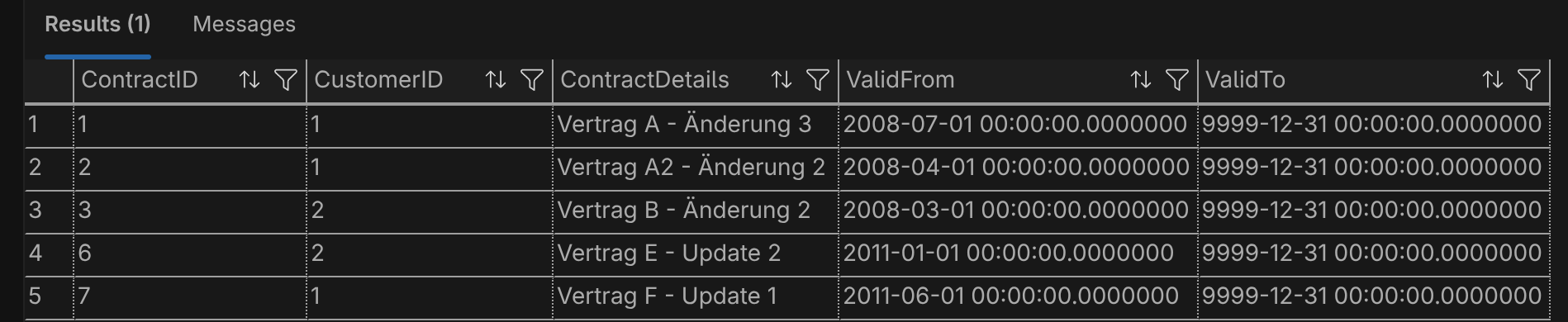
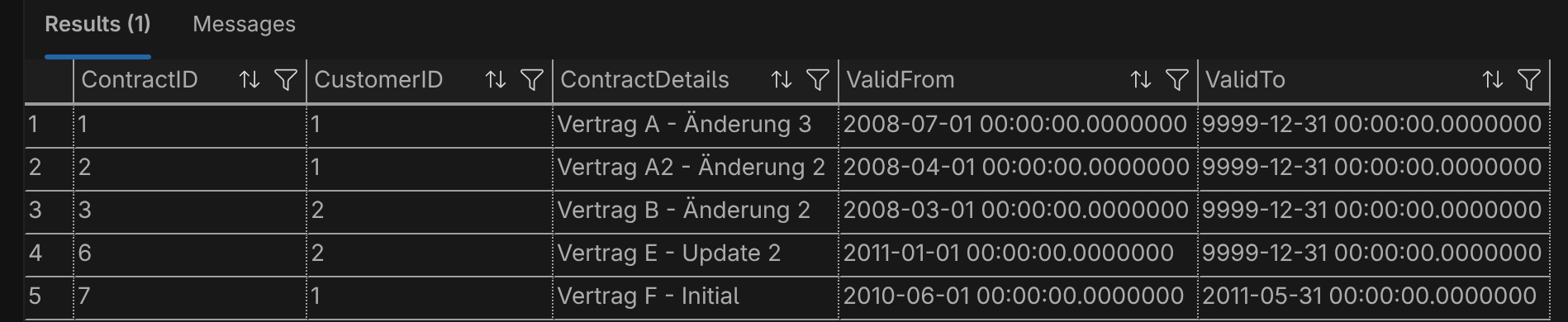
DECLARE @Snap DATETIME2 = '2011-01-01';
SELECT * FROM Contract
WHERE @Snap >= ValidFrom AND @Snap < ValidTo;
g. Alternate solution: point representation (brief)
- Structure (one point = effective date per version):
CREATE TABLE Contract_Point (
  ContractID INT,
  CustomerID INT,
  ContractDetails NVARCHAR(255),
  EffectiveDate DATETIME2,
  CONSTRAINT PK_ContractPoint PRIMARY KEY (ContractID, EffectiveDate)
);

-- Example data (one entity):
INSERT INTO Contract_Point (ContractID, CustomerID, ContractDetails, EffectiveDate) VALUES
(1, 1, 'Vertrag A - Initial', '2023-01-01'),
(1, 1, 'Vertrag A - Änderung 1', '2023-06-01'),
(1, 1, 'Vertrag A - Änderung 2', '2024-01-01');

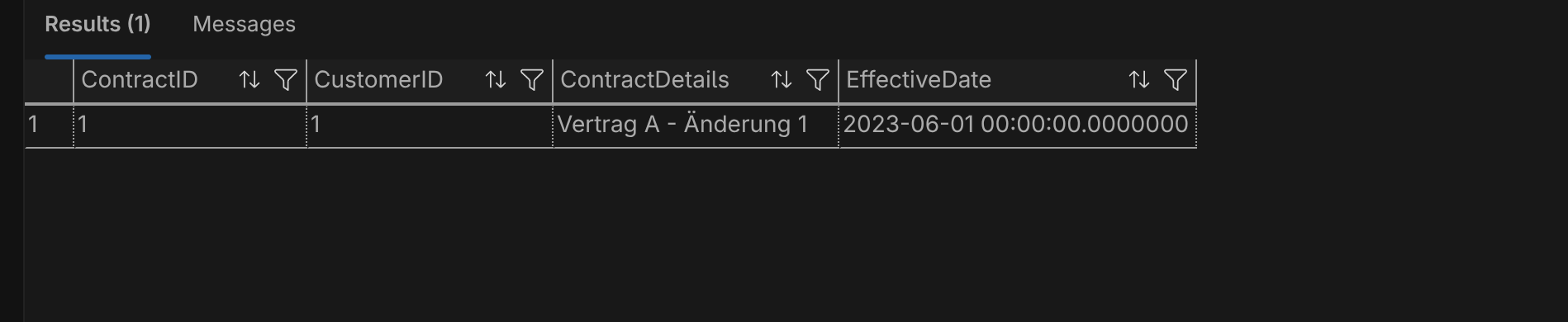
-- Query: state as of a date (pick @D):
-- DECLARE @D DATETIME2 = '2023-10-01';
-- SELECT TOP(1) * FROM Contract_Point
-- WHERE ContractID = 1 AND EffectiveDate <= @D
-- ORDER BY EffectiveDate DESC;
h. Bonus Exercise: Ensure that no overlaps can occur on your table
-- Simple trigger-based protection um sicherzustellen, dass keine überlappenden Zeitintervalle für die gleiche ContractID eingefügt oder aktualisiert werden können:
CREATE OR ALTER TRIGGER TRG_Contract_NoOverlap
ON Contract
AFTER INSERT, UPDATE
AS
BEGIN
  SET NOCOUNT ON;
  IF EXISTS (
    SELECT 1
    FROM Contract c
    JOIN inserted i ON c.ContractID = i.ContractID
    WHERE c.ValidFrom < i.ValidTo AND i.ValidFrom < c.ValidTo
      AND NOT (c.ValidFrom = i.ValidFrom AND c.ValidTo = i.ValidTo)
  )
  BEGIN
    RAISERROR('Interval overlap detected for the same ContractID.', 16, 1);
    ROLLBACK TRANSACTION;
  END
END;
-- Note: Der Trigger prüft, ob es für die gleiche ContractID überlappende Zeitintervalle gibt. Wenn ja, wird eine Fehlermeldung ausgegeben und die Transaktion zurückgesetzt.
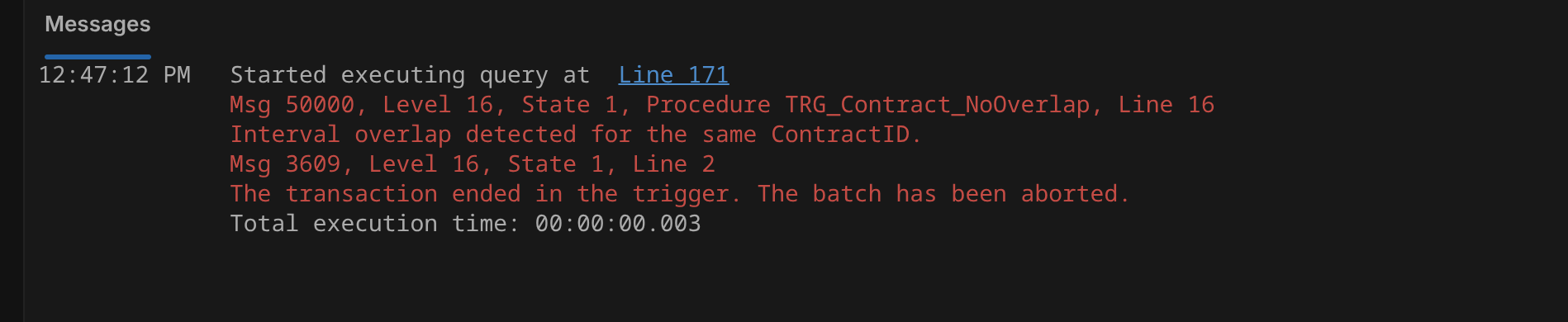
Validierung durch Versuch eines überlappenden Einfügens:
INSERT INTO Contract (ContractID, CustomerID, ContractDetails, ValidFrom, ValidTo)
VALUES (1, 1, 'Vertrag A - Overlap Test', '2012-01-01', '2012-12-31'); -- This should fail due to overlap